
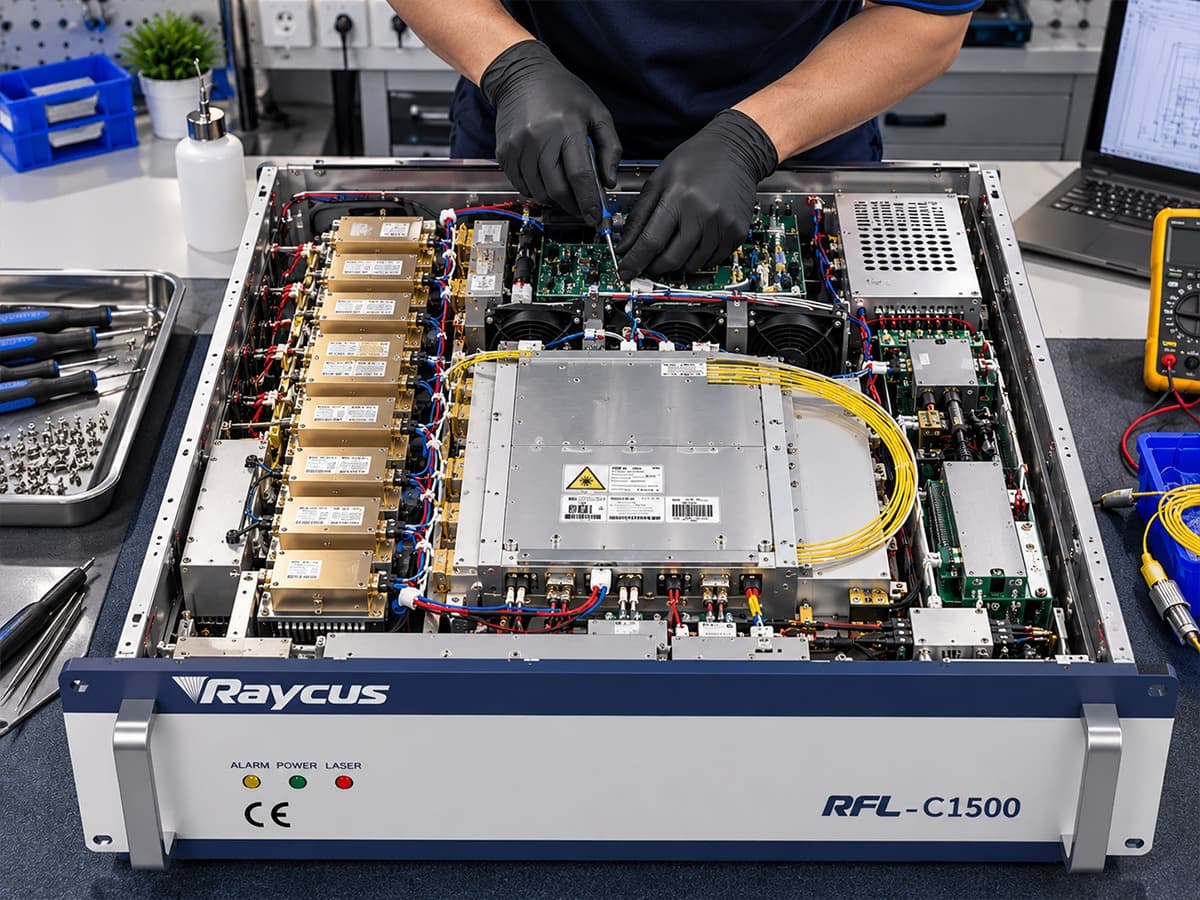
Professional Maintenance for Maxphotonics CW Fiber Lasers
Max Firmware & Telemetry Communication Verification
Our engineers connect to Max internal controllers via RS232 and Ethernet interfaces to verify communication bus integrity, monitor real-time pump diode current, and verify that optical back-reflection threshold sensors are calibrated accurately.
Coolant Flow & Dew-Point Sensor Calibration
Because Max lasers feature sensitive internal dew-point trip sensors, we test sensor accuracy and flush internal heat exchangers to prevent condensation-related shutdowns during humid monsoon periods.
Standard 7-Point Max Service Workflow
Supported Max Models from 1.5kW to 40kW
Max Service Pricing in India
Chiller Water Quality, Conductivity & Dew-Point Condensation Prevention
Recommended Chiller Setpoint Formula for Indian Workshops
To prevent internal condensation, the laser source water temperature (low-temperature circuit) should be set strictly 2°C to 3°C above the ambient workshop dew point, while the cutting head water circuit (high-temperature circuit) is typically maintained between 28°C and 30°C.
Periodic Coolant Flushing & Filter Replacement Schedule
Drain and flush chiller deionized water every 3 months. Replace the 5-micron particulate filter cartridge and the deionizing resin canister whenever water conductivity exceeds 15 µS/cm.
Standard Preventative Maintenance Checklist for Machine Technicians
Electrical Grounding & Surge Suppression Protocol
Industrial fiber laser power supplies are highly sensitive to neutral float and electrical surges from nearby welding sets or induction furnaces. Always maintain a dedicated copper earth pit with grounding resistance below 3 Ohms.
Proper Optical Protective Glass Cleaning Technique
Clean optical lenses only with 99.9% spectrophotometric-grade isopropyl alcohol and lint-free optical wipes. Wipe in a single spiral motion from center to edge; never scrub back and forth.
Engineering Deep Dive: Optical Fiber Physics & Cleanroom Splicing Standards
Double-Clad Active Fiber Geometry & Mode Field Diameter (MFD)
Maintaining exact mode field diameter (MFD) alignment during fiber fusion splicing is essential to prevent high insertion loss and beam quality ($M^2$) degradation. Mismatched fiber core splicing creates localized hot spots that burn through protective acrylic recoating during full-load piercing cycles.
Cladding Mode Stripper (CMS) Overhaul & Thermal Management
Cladding mode strippers remove unabsorbed pump light and back-reflected cladding light before it reaches the delivery cable. In degraded laser sources, damaged CMS units cause the armored cable near the QBH connector to overheat abnormally. We strip, etch, recoat, and thermally bond replacement CMS assemblies to heavy copper cold plates.
Max Laser Servicing: Preventative Audit vs. Unmaintained Operation
Comparing domestic cleanroom restoration versus alternative factory procurement options in India.
| Parameter | TriQuench Preventative Service | Unmaintained Operation |
|---|---|---|
| Optical Conversion Efficiency | Maintained at peak wall-plug efficiency | Efficiency drops, consuming more electricity |
| Chiller Condensation Risk | Calibrated dew-point safety sensors | High risk of internal moisture short-circuit |
| Diode Module Balancing | Balanced current draw across all banks | Uneven diode load leading to premature burn |
| Cutting Speed Consistency | 100% factory cutting speeds | Gradual speed drop requiring operator adjustment |
| Service Documentation | Comprehensive optical test report | No records; unpredictable machine downtime |
Frequently Asked Questions (Real Queries)
Direct, factual answers prepared by our senior optical engineers.
How often should a Max laser source be serviced?
A Max laser source should be professionally serviced every 6 to 12 months or every 3,000 operating hours to maintain optical power stability, prevent diode overheating, and ensure dew-point sensor reliability.
What is included in a Max laser source service?
A Max laser service includes telemetry error history analysis, cleanroom QBH connector cleaning, deionized water cooling channel flushing, thermal compound re-application, and full-power CW load testing.
How long does Max laser source servicing take?
Max laser source servicing takes 24 to 48 hours at our Ahmedabad service center. Onsite technician visits for preventative health checks across major industrial corridors are executed within 24 hours.
Do you calibrate Max dew point and temperature sensors?
Yes, we calibrate internal Max temperature and humidity sensors to prevent premature tripping during hot and humid Indian monsoon conditions.
Can you service high-power Max 12kW and 20kW sources?
Yes, our facility is equipped with water-cooled power dumps and cleanroom optical diagnostic bays capable of servicing Max sources up to 40kW.
Content Director of TriQuench India • Director
12+ Years Industrial Laser Experience [VERIFY]
Specialist in Class 10,000 cleanroom optical fusion splicing, high-power pump diode array balancing, and Raycus, Max, IPG & JPT optoelectronics. Supervised over 500+ laser source repairs across India.