
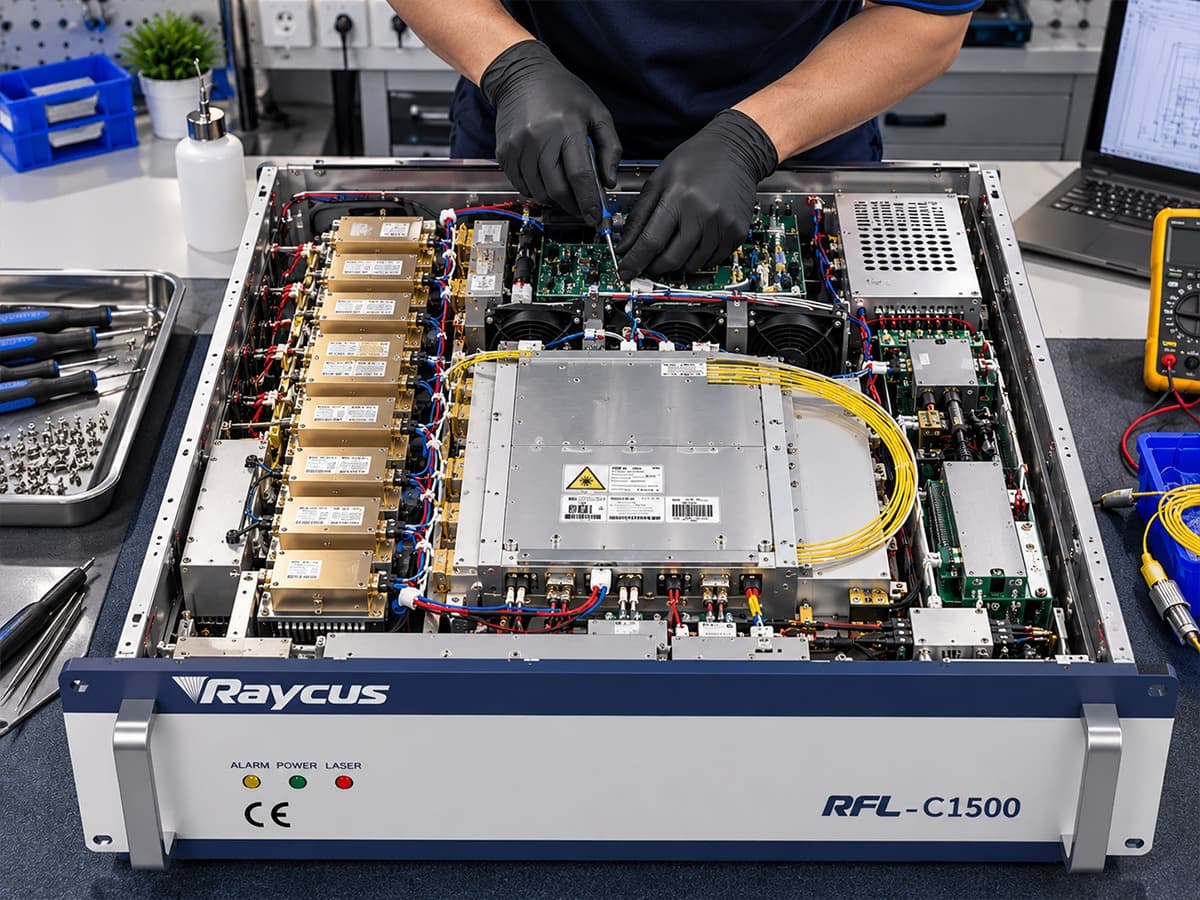
Why Industrial Fiber Lasers Require Preventative Servicing in India
The Silent Killer: Chiller Water Quality & Internal Condensation
Over 60% of laser source failures in Indian workshops originate from coolant contamination or condensation. Standard tap water or unmonitored deionized water causes galvanic corrosion inside water-cooled cold plates. Furthermore, when chiller water is set below the workshop ambient dew point, moisture forms inside the sealed optical cabinet, short-circuiting switching electronics and fogging fiber combiners. Our service protocol includes an in-depth optical dew-point and electrical isolation audit.
Optical Beam Centering & Watt-per-Amp Efficiency Checks
Over 2,000 to 4,000 operational hours, individual diode arrays experience natural electro-optical degradation. Our service engineers measure the precise optical wattage produced per ampere of input current using water-cooled power dumps, ensuring your laser source operates at peak electrical efficiency.
Complete 8-Point Fiber Laser Source Service Checklist
1. Diagnostic Telemetry & Fault Log Extraction
Connecting to internal DSP controller via RS232/Ethernet to analyze historical alarms, diode run-times, and module current draw.
2. ISO Class 7 Cleanroom Optical Inspection
Inspecting delivery fiber end-blocks, cladding mode strippers, and internal combiner splices under high-magnification optical microscopes.
3. QBH Connector Quartz Block Cleaning & Centering
Polishing and cleaning the protective quartz output block with 99.9% spectrophotometric-grade alcohol, verifying zero surface spatter.
4. Internal Heat Sink & Coolant Flushing
Flushing deionized water cooling loops, removing micro-scaling, and replacing high-conductivity thermal paste between diode modules and cold plates.
5. Switching Power Supply & Safety Interlock Audit
Inspecting high-voltage capacitors, checking relay response times, and testing safety emergency stop circuits.
6. Dew-Point Sensor Calibration & Sealing
Testing internal humidity sensors and replacing silicone airtight chassis gaskets to prevent airborne dust ingress.
7. Full-Load CW Power Calibration up to 30kW
Firing the laser into calibrated water-cooled optical dumps to verify continuous wave wattage and beam stability across all duty cycles.
8. Comprehensive Service Certificate & Test Report
Issuing an itemized engineering report documenting input power, output wattage, beam stability percentage, and maintenance recommendations.
Annual Maintenance Contracts (AMC) for Indian Fabricators
Supported Brands at Our National Service Hub
Chiller Water Quality, Conductivity & Dew-Point Condensation Prevention
Recommended Chiller Setpoint Formula for Indian Workshops
To prevent internal condensation, the laser source water temperature (low-temperature circuit) should be set strictly 2°C to 3°C above the ambient workshop dew point, while the cutting head water circuit (high-temperature circuit) is typically maintained between 28°C and 30°C.
Periodic Coolant Flushing & Filter Replacement Schedule
Drain and flush chiller deionized water every 3 months. Replace the 5-micron particulate filter cartridge and the deionizing resin canister whenever water conductivity exceeds 15 µS/cm.
Standard Preventative Maintenance Checklist for Machine Technicians
Electrical Grounding & Surge Suppression Protocol
Industrial fiber laser power supplies are highly sensitive to neutral float and electrical surges from nearby welding sets or induction furnaces. Always maintain a dedicated copper earth pit with grounding resistance below 3 Ohms.
Proper Optical Protective Glass Cleaning Technique
Clean optical lenses only with 99.9% spectrophotometric-grade isopropyl alcohol and lint-free optical wipes. Wipe in a single spiral motion from center to edge; never scrub back and forth.
Engineering Deep Dive: Optical Fiber Physics & Cleanroom Splicing Standards
Double-Clad Active Fiber Geometry & Mode Field Diameter (MFD)
Maintaining exact mode field diameter (MFD) alignment during fiber fusion splicing is essential to prevent high insertion loss and beam quality ($M^2$) degradation. Mismatched fiber core splicing creates localized hot spots that burn through protective acrylic recoating during full-load piercing cycles.
Cladding Mode Stripper (CMS) Overhaul & Thermal Management
Cladding mode strippers remove unabsorbed pump light and back-reflected cladding light before it reaches the delivery cable. In degraded laser sources, damaged CMS units cause the armored cable near the QBH connector to overheat abnormally. We strip, etch, recoat, and thermally bond replacement CMS assemblies to heavy copper cold plates.
Routine Laser Servicing vs. Run-to-Failure Breakdown
Comparing domestic cleanroom restoration versus alternative factory procurement options in India.
| Operating Parameter | Scheduled Preventative Servicing | Run-to-Failure Breakdown |
|---|---|---|
| Annual Maintenance Cost | Low, predictable scheduled investment | High emergency repair bills (₹1.5L – ₹4L+) |
| Laser Diode Lifespan | Extended to 100,000+ operating hours | Premature burnout within 2–3 years |
| Unplanned Factory Downtime | Virtually zero unplanned stoppage | 2 to 4 weeks sudden production shutdown |
| Sheet Metal Cutting Quality | Consistent dross-free edge finish | Frequent dross, slag, and piercing failures |
| Quality Assurance & Support | Active certified support & technical SLA | No coverage; full commercial risk |
Frequently Asked Questions (Real Queries)
Direct, factual answers prepared by our senior optical engineers.
What is included in a fiber laser source service in India?
A fiber laser source service includes diagnostic telemetry analysis, ISO Class 7 cleanroom optical inspection, QBH quartz cleaning, coolant loop flushing, diode module efficiency testing, dew-point sensor calibration, and full-load CW power testing with a certified report.
How often should a fiber laser source be serviced?
A fiber laser source should undergo professional servicing every 6 to 12 months or every 3,000 operating hours. In dusty or high-humidity Indian workshop conditions, bi-annual inspections prevent unexpected optical combiner and pump diode failures.
How much does laser source servicing cost in India?
Standard preventative laser source servicing in India costs between ₹15,000 and ₹45,000 [VERIFY] depending on wattage and travel distance for onsite inspections. Full cleanroom laboratory servicing and recalibration range from ₹25,000 to ₹65,000.
Where is your fiber laser service center located?
Our central optical cleanroom service center is located at Sumel Business Park - 7, Rakhial, Ahmedabad, Gujarat. We serve manufacturing plants across Maharashtra, Punjab, Tamil Nadu, Karnataka, and Delhi NCR via insured logistics pickup.
Do you offer Annual Maintenance Contracts (AMC) for laser cutting machines?
Yes, TriQuench India offers comprehensive and semi-comprehensive AMC packages for fiber laser sources and cutting heads, including scheduled preventative audits, priority emergency engineer dispatch, and discounted replacement spares.
Content Director of TriQuench India • Director
12+ Years Industrial Laser Experience [VERIFY]
Specialist in Class 10,000 cleanroom optical fusion splicing, high-power pump diode array balancing, and Raycus, Max, IPG & JPT optoelectronics. Supervised over 500+ laser source repairs across India.