
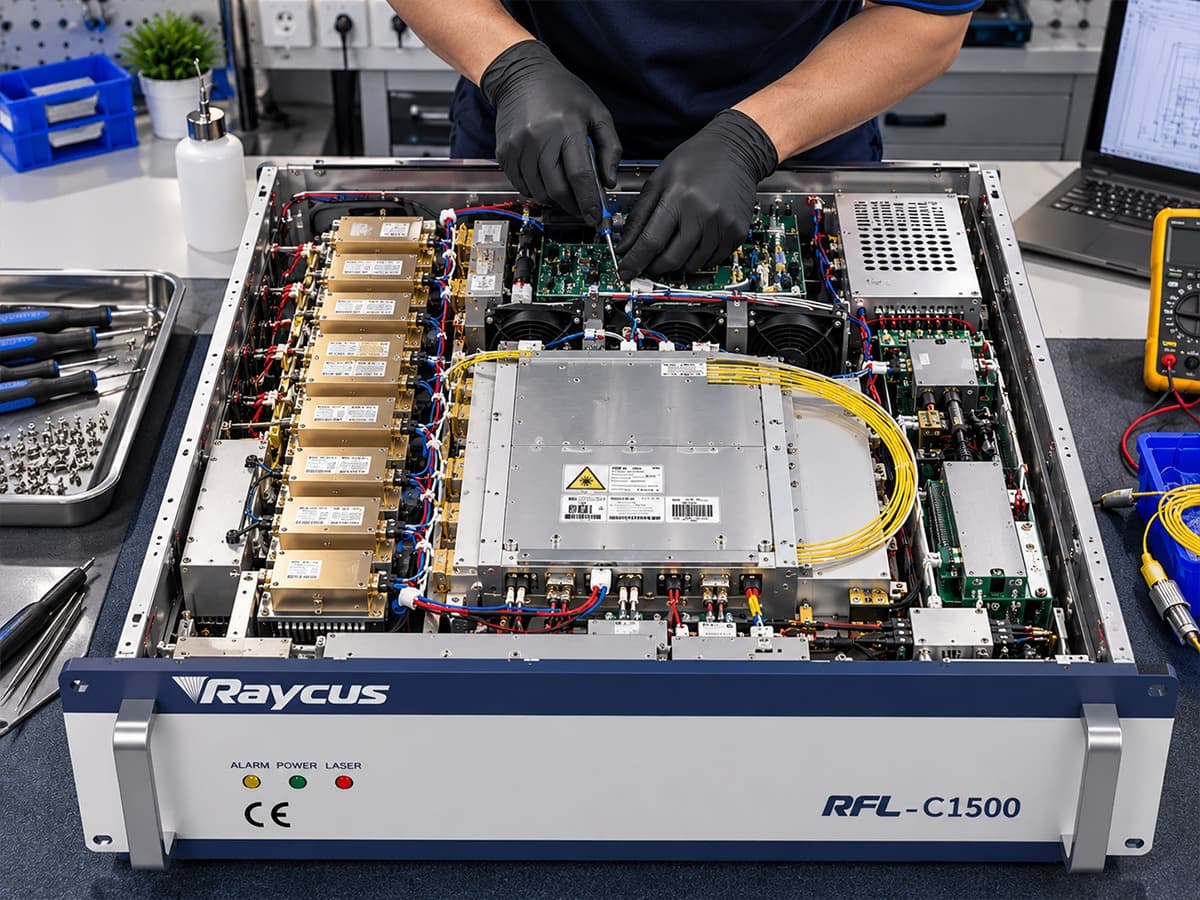
Why Indian Sheet Metal Workshops Need Localized Laser Source Repair
What Happens Inside a Degrading Fiber Laser Resonator?
Industrial continuous-wave (CW) fiber lasers combine multiple high-power 915nm or 976nm pump laser diodes into an active ytterbium-doped double-clad optical fiber through fused fiber combiners. In harsh Indian factory environments characterized by ambient temperatures above 40°C, airborne metal dust, and fluctuating grid voltage, individual diode bars can burn out or drift in wavelength. This causes thermal runaway, optical combiner micro-fractures, or burnt cladding mode strippers that vent heat directly into the delivery cable armor.
The Danger of Open-Air Workshop Splicing
A critical reality factory owners must understand is that optical fiber core splicing cannot be performed in normal factory shop-floor air. Bare 50-micron or 100-micron quartz fibers carrying 3kW to 12kW of continuous 1080nm infrared light will vaporize instantly if microscopic oil droplets or airborne dust particles settle on the splice joint. TriQuench India performs every optical recleave, fiber recoat, and fusion splice inside a sealed ISO Class 7 (Class 10,000) optical cleanroom using automated 3-axis core-alignment fusion splicers.
Step-by-Step Cleanroom Laser Source Repair Protocol
1. Digital RS232/Ethernet Telemetry Interrogation
Before unsealing any optical cover, our diagnostics engineers interface with the internal DSP microprocessor via RS232, CAN bus, or Ethernet. We download error event histories, individual pump module current curves, photodiode back-reflection values, and temperature logs to isolate the exact component failure without trial-and-error.
2. Cleanroom De-casing & Microscopic Inspection
The unit is transferred into our antistatic cleanroom. Under laminar flow hoods, optical engineers inspect quartz end-blocks, cladding mode strippers (CMS), fiber combiners, and fused fiber tapers under 200x magnification optical microscopes to detect thermal micro-cracking or core scorches.
3. Diode Module Balancing & Precision Fusion Splicing
Faulty 976nm/915nm pump diode modules are removed and replaced with genuine, wavelength-matched units. Bare fiber ends are cleaved using precision automated diamond cleavers to achieve an end-face angle below 0.5 degrees. Splices are fused with insertion loss verified under 0.02 dB.
4. Cooling Circuit Pressure & Dew-Point Testing
The internal deionized water cooling plates are pressure-tested at 6 Bar to guarantee zero micro-leakage. We inspect internal dew-point safety sensors to protect against condensation-induced power board failures during humid monsoon cycles.
5. High-Power CW Endurance Burn-In Test
The repaired source is integrated with an industrial dual-circuit chiller and connected to an optical water-cooled beam dump. We run continuous full-power endurance cycles at 100% CW output for 4 to 8 hours, verifying output stability within ±1.5% before releasing the machine.
Brands and Power Ranges Supported Nationwide
Repair Pricing Structure & Factors Affecting Cost in India
Engineering Deep Dive: Optical Fiber Physics & Cleanroom Splicing Standards
Double-Clad Active Fiber Geometry & Mode Field Diameter (MFD)
Maintaining exact mode field diameter (MFD) alignment during fiber fusion splicing is essential to prevent high insertion loss and beam quality ($M^2$) degradation. Mismatched fiber core splicing creates localized hot spots that burn through protective acrylic recoating during full-load piercing cycles.
Cladding Mode Stripper (CMS) Overhaul & Thermal Management
Cladding mode strippers remove unabsorbed pump light and back-reflected cladding light before it reaches the delivery cable. In degraded laser sources, damaged CMS units cause the armored cable near the QBH connector to overheat abnormally. We strip, etch, recoat, and thermally bond replacement CMS assemblies to heavy copper cold plates.
Back-Reflection Physics: Safely Cutting Brass, Copper & Aluminum
Symptoms of Back-Reflection Damage in Laser Sources
Initial signs of back-reflection damage include intermittent "Optical Reflection Alarm" trips, rapid burning of protective cover slides in the cutting head, and warm armored delivery cables during copper cutting.
Cleanroom Optical Isolator & Photodiode Recalibration
When back-reflection damage occurs, we open the combiner housing in our ISO Class 7 cleanroom, replace scorched beam dumps and damaged sensor photodiodes, and recalibrate threshold voltages using precision laser test benches.
Chiller Water Quality, Conductivity & Dew-Point Condensation Prevention
Recommended Chiller Setpoint Formula for Indian Workshops
To prevent internal condensation, the laser source water temperature (low-temperature circuit) should be set strictly 2°C to 3°C above the ambient workshop dew point, while the cutting head water circuit (high-temperature circuit) is typically maintained between 28°C and 30°C.
Periodic Coolant Flushing & Filter Replacement Schedule
Drain and flush chiller deionized water every 3 months. Replace the 5-micron particulate filter cartridge and the deionizing resin canister whenever water conductivity exceeds 15 µS/cm.
Fiber Laser Source: Cleanroom Repair vs. OEM Replacement
Comparing domestic cleanroom restoration versus alternative factory procurement options in India.
| Evaluation Parameter | Cleanroom Repair (TriQuench India) | New OEM Replacement Source |
|---|---|---|
| Average Cost (3kW Unit) | ₹75,000 – ₹1,60,000 + GST | ₹4,50,000 – ₹6,50,000 + GST [VERIFY] |
| Workshop Downtime | 24 to 48 Hours Turnaround | 3 to 6 Weeks (Import Customs & Airfreight) |
| Quality Assurance | 100% Bench Tested & Verified | Standard Factory Terms |
| Laser Power Output | 100% Calibrated CW Wattage | 100% Factory Standard |
| Capital Cash Flow Impact | Low operational maintenance expense (OPEX) | Substantial capital outlay (CAPEX) |
Frequently Asked Questions (Real Queries)
Direct, factual answers prepared by our senior optical engineers.
How much does fiber laser source repair cost in India?
Fiber laser source repair in India costs between ₹35,000 and ₹2,80,000 depending on the brand, wattage, and damaged components. Minor electronic interlock and sensor repairs range from ₹35,000 to ₹55,000, while QBH armored cable replacement and diode module overhauls range from ₹65,000 to ₹2,80,000.
What is the turnaround time for fiber laser source repair in India?
The turnaround time for fiber laser source repair at TriQuench India is 24 to 48 hours for standard cleanroom diagnostics and diode splicing. Emergency same-day diagnostics are provided for urgent breakdowns across Gujarat and western industrial corridors.
Can optical fiber splicing be performed on-site at my factory?
Optical fiber core splicing cannot be performed on-site on an open workshop floor because airborne dust and oil vapor will contaminate the glass core. Splicing bare kilowatt fibers requires an ISO Class 7 cleanroom environment to achieve sub-0.02 dB insertion loss.
What quality assurance is provided on repaired fiber laser sources?
TriQuench India provides 100% bench testing and certified technical support on all replaced optical diode modules, fused fiber splices, and electronic driver components. Repaired units are verified for full rated output under standard industrial operating conditions.
Why does my fiber laser suddenly lose 40% cutting power?
A fiber laser loses cutting power primarily due to burnt 976nm pump diode modules, degraded internal fiber splices, or a damaged QBH quartz output window. Power drops require cleanroom bench testing to balance pump diode modules and recalibrate output wattage.
How can I transport a faulty fiber laser source safely to Ahmedabad?
To transport a laser source safely, drain all chiller coolant completely, secure the protective QBH optical cap, maintain an armored cable bend radius above 200mm, and pack the unit in a shock-damped wooden crate. We arrange insured logistics pickup directly from your factory.
Content Director of TriQuench India • Director
12+ Years Industrial Laser Experience [VERIFY]
Specialist in Class 10,000 cleanroom optical fusion splicing, high-power pump diode array balancing, and Raycus, Max, IPG & JPT optoelectronics. Supervised over 500+ laser source repairs across India.