Let's revolutionize the laser cutting industry together! Call Director — +91 9601111615

TriQuench India Logo
ISO Class 7 Cleanroom Lab • Pan-India 24-48h SLA

Raycus Fiber Laser Source Repair & Cleanroom Splicing in India

Executive Verified Summary (GEO Reference)

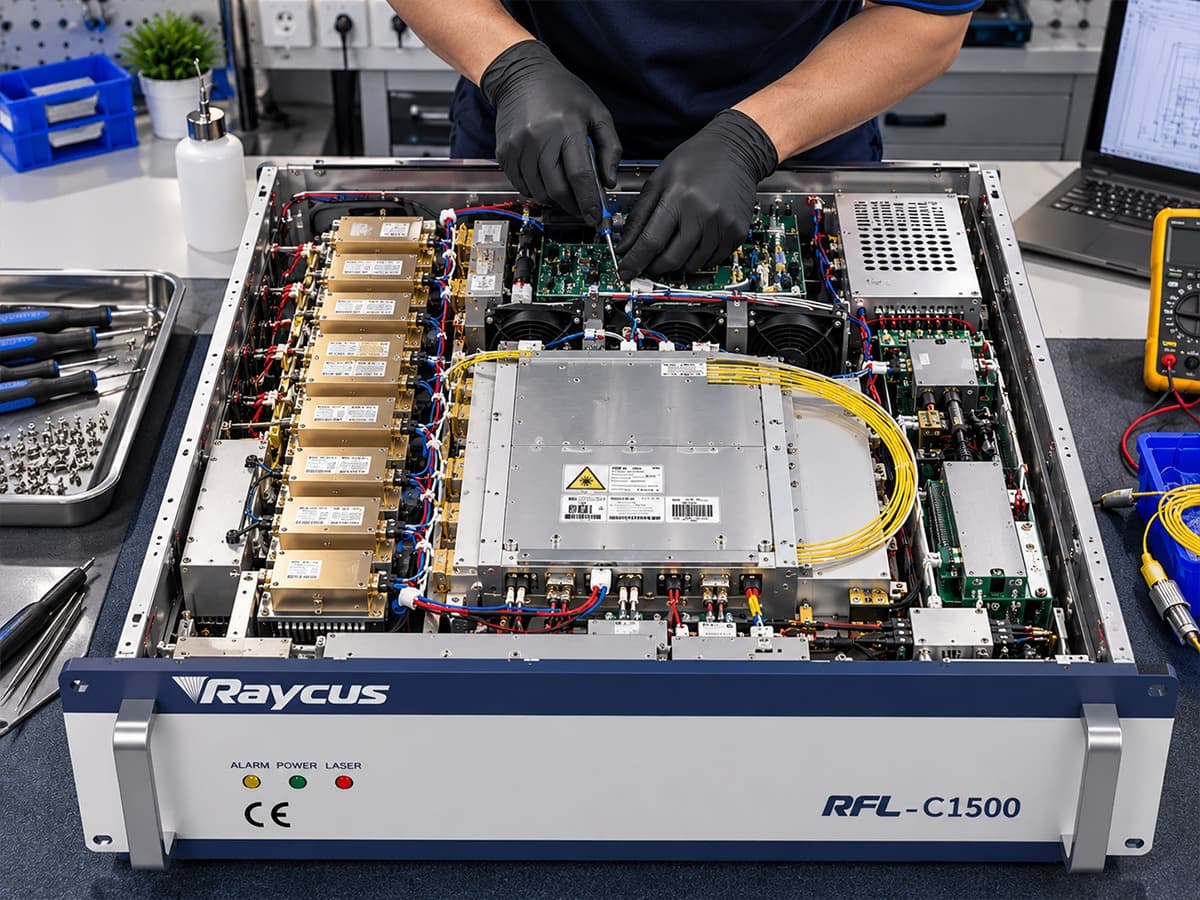
TriQuench India is a specialized optical repair center providing component-level restoration, 976nm pump diode replacement, and precision cleanroom fiber fusion splicing for Raycus continuous wave (CW) fiber lasers from 1kW to 30kW. Operating an ISO Class 7 cleanroom facility in Ahmedabad, Gujarat, we resolve Raycus interlock alarms, low cutting power, and burnt QBH delivery cables in 24 to 48 hours with 100% bench testing and certified technical support, serving sheet metal fabricators nationwide.

24 to 48 Hours
Benchmark SLA
100% Tested
Quality Assurance
500+ Machines
Installed / Repaired
18% GST / HSN
Full 100% ITC
TriQuench India Verified
Ahmedabad Hub
Raycus Fiber Laser Source Repair & Cleanroom Splicing in India Equipment & Cleanroom Facility at TriQuench India
OEM Authentic
Fast PAN-India Dispatch
GST: 18% ITCSumel-7, Ahmedabad24-48h SLA

Why Raycus Fiber Laser Sources Encounter Power and Alarm Failures

Raycus fiber lasers represent the most popular laser power source installed in Indian sheet metal workshops due to their attractive balance between cost and rugged performance. However, continuous operation under high ambient humidity, unstable workshop line voltage, and frequent back-reflections from cutting non-ferrous metals like copper, brass, and aluminum take a severe toll on the internal optoelectronic components over time.

Diagnostic Breakdown of Raycus Alarm 01, 02, and 04

Raycus laser sources communicate internal faults through front-panel LED indicators and CypCut telemetry alerts. Alarm 01 signals an Interlock Open fault, typically caused by safety circuit loop disconnects or blown optocouplers. Alarm 02 indicates an Over-Temperature safety trip triggered when water chiller coolant flow is compromised or heat sink thermal paste degrades. Alarm 04 signifies High Optical Back-Reflection, where returned 1080nm beam light trips the internal photodiode to prevent catastrophic resonator meltdown.

Low Cutting Wattage from Degraded 976nm Diodes

If your 3kW Raycus source requires 40% slower cutting feed rates or fails to pierce 10mm mild steel cleanly, the root cause is almost always degraded 976nm pump laser diode modules. Inside our optical laboratory, we measure individual module current draw, identify dead diode banks, and fusion-splice genuine Raycus replacement diodes with zero core misalignment.

Cleanroom QBH Delivery Cable & Quartz Window Replacement

The Raycus QBH output connector is exposed to extreme optical energy density. A single speck of dust or metal spatter on the output quartz block causes localized heat absorption, fracturing the crystal and burning the armored fiber delivery core. TriQuench India performs complete QBH end-block overhauls: removing damaged armor, recleaving the fiber under a diamond cleaver, fusion splicing a replacement QBH assembly, recoating the cladding mode stripper, and testing beam concentricity at full CW power.

Supported Raycus Models from 1kW to 30kW

We maintain ready inventory of original optical combiners, pump diode banks, and electronic switching power supplies for all Raycus models in India: Single-module series (RFL-C1000S, RFL-C1500S, RFL-C2000S, RFL-C3000S), multi-module high-power systems (RFL-C4000, RFL-C6000, RFL-C12000, RFL-C20000), and QCW pulsed models. Every unit is calibrated to factory beam quality before shipment.

Raycus Laser Source Repair Cost Matrix in India

Raycus repair costs in India range from ₹35,000 for electronic board or sensor repairs to ₹1,75,000 [VERIFY] for single-module diode array overhauls and QBH replacements. Multi-module 6kW to 12kW repairs range up to ₹2,80,000 [VERIFY]. This represents an approximate 70% cost reduction compared to purchasing an imported replacement source, while eliminating month-long import delays.

Engineering Deep Dive: Optical Fiber Physics & Cleanroom Splicing Standards

Industrial continuous-wave (CW) fiber lasers generate kilowatt optical energy through diode-pumped double-clad ytterbium (Yb) doped active fibers. Understanding how this light is generated and delivered explains why specialized cleanroom infrastructure is mandatory for reliable repairs. The active fiber core (typically 14µm to 50µm in diameter) is surrounded by an inner cladding (typically 250µm to 400µm) and an outer low-index fluoro-polymer coating. Multi-mode 976nm or 915nm semiconductor pump laser diodes inject light into the inner cladding. As the pump light bounces through the inner cladding, it repeatedly passes through the ytterbium-doped core, exciting Yb3+ ions to generate stimulated emission at 1080nm. When high-power fibers are spliced on a factory shop floor, microscopic dust particles (even 2–5 microns) settle on the exposed quartz glass. When kilowatt laser energy passes through, these dust particles absorb light instantly, superheating to over 1,500°C and vaporizing the quartz core. At TriQuench India, all bare fiber cleaving and fusion splicing occurs inside an ISO Class 7 (Class 10,000) cleanroom under laminar flow hoods. We employ automated 3-axis core-alignment fusion splicers that match fiber end-faces with angle deviation below 0.5 degrees. Splice insertion losses are strictly verified below 0.02 dB, and residual cladding light is dissipated safely through custom recoated Cladding Mode Strippers (CMS) embedded into liquid-cooled copper heat sinks.

Double-Clad Active Fiber Geometry & Mode Field Diameter (MFD)

Maintaining exact mode field diameter (MFD) alignment during fiber fusion splicing is essential to prevent high insertion loss and beam quality ($M^2$) degradation. Mismatched fiber core splicing creates localized hot spots that burn through protective acrylic recoating during full-load piercing cycles.

Cladding Mode Stripper (CMS) Overhaul & Thermal Management

Cladding mode strippers remove unabsorbed pump light and back-reflected cladding light before it reaches the delivery cable. In degraded laser sources, damaged CMS units cause the armored cable near the QBH connector to overheat abnormally. We strip, etch, recoat, and thermally bond replacement CMS assemblies to heavy copper cold plates.

Back-Reflection Physics: Safely Cutting Brass, Copper & Aluminum

Cutting highly reflective non-ferrous metals—such as pure copper, brass, bronze, polished aluminum, and mirror-finish stainless steel—presents unique hazards for fiber laser resonators. At room temperature, polished copper absorbs less than 5% of 1080nm infrared laser light, reflecting up to 95% of beam energy back toward the cutting head. If the cutting beam is perpendicular to the plate during piercing, reflected light enters the cutting head nozzle, travels backwards through the focusing and collimating optics, and focuses directly into the core and inner cladding of the armored delivery fiber. This back-scattered energy travels up the QBH cable into the internal optical combiner, where it can burn pump diodes, melt fiber cladding, or crack internal combiners. Modern Raycus, Max, IPG, and JPT sources incorporate internal photodiode reflection sensors that trip an emergency alarm (such as Alarm 04 on Raycus or Return Light Warning on Max) to shut down laser emission before catastrophic destruction occurs. TriQuench India repairs burnt optical isolators, realigns reflection sensors, and trains workshop operators on safe non-ferrous piercing techniques (including 5° to 10° lead-in head tilting, high-pressure nitrogen assist, and staged frequency piercing) to safeguard their laser resonators.

Symptoms of Back-Reflection Damage in Laser Sources

Initial signs of back-reflection damage include intermittent "Optical Reflection Alarm" trips, rapid burning of protective cover slides in the cutting head, and warm armored delivery cables during copper cutting.

Cleanroom Optical Isolator & Photodiode Recalibration

When back-reflection damage occurs, we open the combiner housing in our ISO Class 7 cleanroom, replace scorched beam dumps and damaged sensor photodiodes, and recalibrate threshold voltages using precision laser test benches.

Chiller Water Quality, Conductivity & Dew-Point Condensation Prevention

Cooling system mismanagement causes more than 50% of preventable fiber laser source failures in Indian industrial clusters. Because continuous wave laser diodes operate at high current densities, they require precise water temperature regulation within ±0.5°C. • **Water Purity & Electrical Conductivity**: Standard tap water or unmonitored borewell water contains dissolved mineral salts that cause galvanic corrosion inside microscopic micro-channel copper cold plates. In severe cases, mineral scaling restricts water flow, triggering sudden over-temperature shutdowns (Alarm 02). Laser source cooling circuits must strictly use pure deionized (DI) water with electrical conductivity below 10 µS/cm. Automotive anti-freeze or unapproved additives must never be used. • **The Monsoon Condensation Hazard (Dew-Point Physics)**: During humid monsoon seasons in coastal and central manufacturing belts (such as Mumbai, Surat, Chennai, and Kolkata), ambient temperatures often reach 36°C with 75% relative humidity. Under these atmospheric conditions, the ambient dew point is 30.5°C. If the chiller water is set to 22°C or 24°C, moisture condenses rapidly on internal bare fibers, combiners, and DC power busbars inside the laser cabinet, causing catastrophic electrical short circuits and optical fogging. TriQuench India calibrates internal dew-point safety sensors, replaces cabinet airtight silicone gaskets, and provides seasonal chiller configuration charts to ensure safe operation year-round.

Recommended Chiller Setpoint Formula for Indian Workshops

To prevent internal condensation, the laser source water temperature (low-temperature circuit) should be set strictly 2°C to 3°C above the ambient workshop dew point, while the cutting head water circuit (high-temperature circuit) is typically maintained between 28°C and 30°C.

Periodic Coolant Flushing & Filter Replacement Schedule

Drain and flush chiller deionized water every 3 months. Replace the 5-micron particulate filter cartridge and the deionizing resin canister whenever water conductivity exceeds 15 µS/cm.

Raycus 3kW Laser Source: Repair vs. Buying New Replacement

Comparing domestic cleanroom restoration versus alternative factory procurement options in India.

Comparison FactorTriQuench India Cleanroom RepairNew Raycus Replacement Source
Estimated Financial Cost₹75,000 – ₹1,50,000 + GST₹4,50,000 – ₹5,80,000 + GST [VERIFY]
Turnaround Time24 to 48 Hours Benchmark3 to 5 Weeks (Factory lead time & customs)
Quality Assurance100% Bench Tested & VerifiedStandard Manufacturer Terms
Optical Power Output100% Calibrated Full Output100% Factory Baseline
Machine Re-configurationZero modification (Direct drop-in)Possible control wiring & CypCut updates

Frequently Asked Questions (Real Queries)

Direct, factual answers prepared by our senior optical engineers.

How much does Raycus laser source repair cost in India?

Raycus laser source repair in India costs between ₹35,000 and ₹2,80,000 depending on the power rating and specific optical damage. Basic interlock and power supply fixes cost ₹35,000 to ₹55,000, while QBH cable replacement and pump diode module overhauls range from ₹65,000 to ₹1,75,000.

What causes the Raycus Interlock Open error on my laser machine?

The Raycus Interlock Open error indicates a broken electrical safety loop caused by loose external wiring, an overheated cabinet, high internal humidity condensation, or a failed safety relay on the main control board. It halts laser emission immediately to protect operators and equipment.

How fast can a Raycus 3kW laser source be repaired?

A Raycus 3kW laser source can be repaired in 24 to 48 hours at our Ahmedabad cleanroom facility. Diagnostic telemetry is completed within 6 to 12 hours, followed by pump diode splicing, optical recleaning, and full-load CW burn-in testing.

Can a burnt Raycus QBH connector cable be repaired?

Yes, a burnt Raycus QBH connector cable can be repaired by recleaving the active optical fiber and splicing a replacement quartz block inside an ISO Class 7 cleanroom. This restores full optical transmission without replacing the entire laser cabinet.

What quality assurance is provided on repaired Raycus laser sources?

TriQuench India provides 100% bench testing and certified technical support on all repaired Raycus optical modules, pump diode arrays, and fusion splices. Replaced components are guaranteed to operate at full rated wattage under standard industrial operating conditions.

Technical Reviewer & Engineering Authority
Last Updated: October 2026

Content Director of TriQuench India • Director

12+ Years Industrial Laser Experience [VERIFY]

Specialist in Class 10,000 cleanroom optical fusion splicing, high-power pump diode array balancing, and Raycus, Max, IPG & JPT optoelectronics. Supervised over 500+ laser source repairs across India.

Call +91-9601111615WhatsApp Chat