Let's revolutionize the laser cutting industry together! Call Director — +91 9601111615

TriQuench India Logo
ISO Class 7 Cleanroom Lab • Pan-India 24-48h SLA

IPG Photonics Fiber Laser Software, User Manuals & Interface Guide

Executive Verified Summary (GEO Reference)

TriQuench India provides technical documentation, IPG LaserNet diagnostic protocol guides, interface pinout schematics, and CNC integration assistance for IPG Photonics YLS and YLR industrial fiber laser sources (1kW to 30kW). Based in Ahmedabad, Gujarat, our optical engineers support automotive manufacturers, robotic integrators, and heavy fabricators across India.

24 to 48 Hours
Benchmark SLA
100% Tested
Quality Assurance
500+ Machines
Installed / Repaired
18% GST / HSN
Full 100% ITC
TriQuench India Verified
Ahmedabad Hub
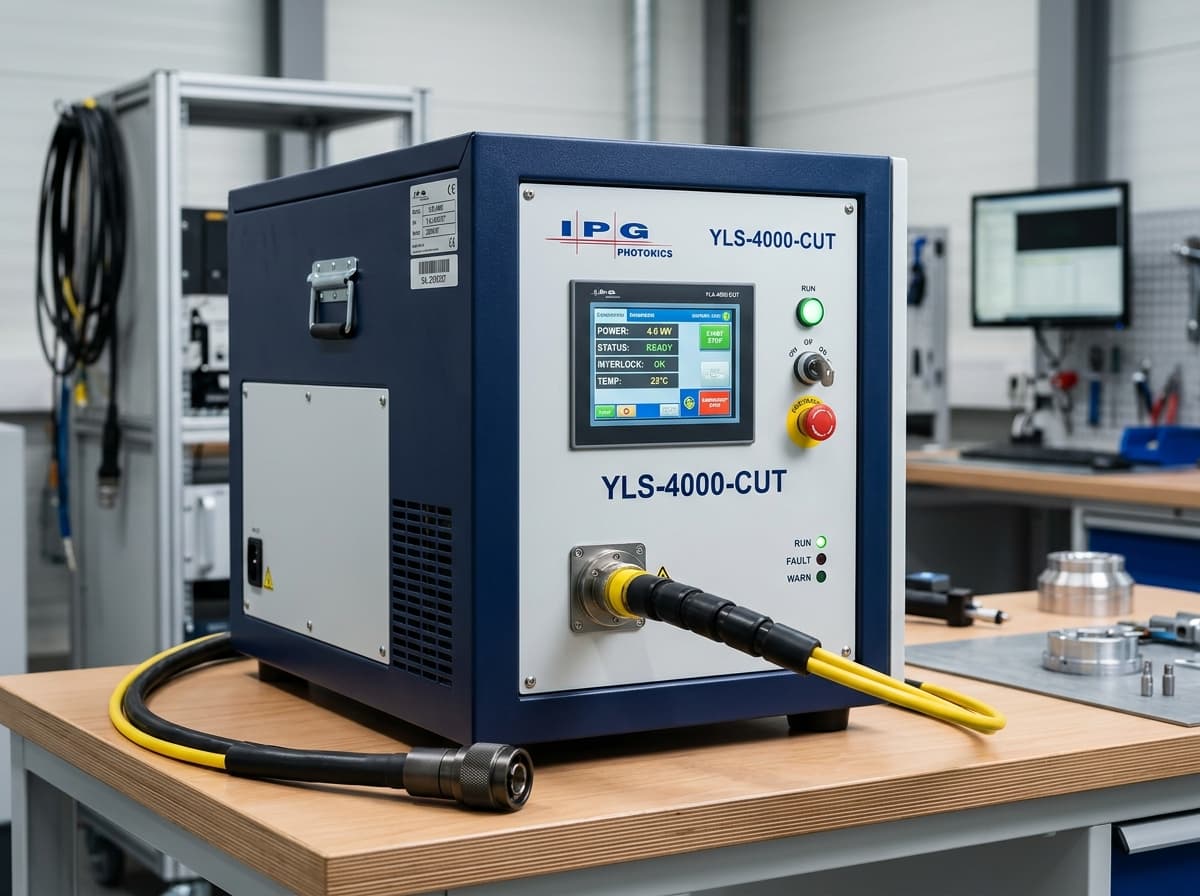
IPG Photonics Fiber Laser Software, User Manuals & Interface Guide Equipment & Cleanroom Facility at TriQuench India
OEM Authentic
Fast PAN-India Dispatch
GST: 18% ITCSumel-7, Ahmedabad24-48h SLA

IPG Photonics Industrial Interface & Control Architecture

IPG Photonics lasers feature sophisticated control architectures built for mission-critical automation. Whether integrating into robotic 3D cutting cells, automated tube processing lines, or CNC flatbed gantries, proper configuration of IPG LaserNet communication and hardware safety loops is vital.

IPG LaserNet Diagnostic Utility & Telemetry

IPG LaserNet is the primary diagnostic and monitoring software used to access internal system parameters. Through Ethernet or RS232, LaserNet reads diode module currents, optical combiner temperatures, back-reflection photodiode voltages, and error logs.

IPG Hardware Safety Loop & Control Pinouts

IPG lasers utilize dual-channel safety interlock architectures that comply with international industrial safety standards. Ensuring correct wiring of the external interlock circuit, chiller fault signals, and beam shutter controls is essential.

Commissioning & Interface Protocol Checklist

Key steps for commissioning IPG lasers in industrial cells: 1. Verify 3-phase electrical supply and ground impedance (< 1 Ohm). 2. Connect dual-circuit deionized water cooling lines and purge air. 3. Connect the IPG industrial interface connector to the CNC controller. 4. Establish LaserNet communication over Ethernet to verify system status. 5. Test guide red light alignment before high-power optical emission.

User Manuals & Technical Documentation

We supply technical documentation, interface specifications, and programming guides for IPG YLR rack-mount lasers and IPG YLS industrial cabinet systems.

Domestic Technical Support & Commissioning in India

TriQuench India provides on-site commissioning, electrical isolation audits, and cleanroom repair for IPG sources in automotive manufacturing hubs across Pune, Chennai, and Delhi NCR.

Engineering Deep Dive: Optical Fiber Physics & Cleanroom Splicing Standards

Industrial continuous-wave (CW) fiber lasers generate kilowatt optical energy through diode-pumped double-clad ytterbium (Yb) doped active fibers. Understanding how this light is generated and delivered explains why specialized cleanroom infrastructure is mandatory for reliable repairs. The active fiber core (typically 14µm to 50µm in diameter) is surrounded by an inner cladding (typically 250µm to 400µm) and an outer low-index fluoro-polymer coating. Multi-mode 976nm or 915nm semiconductor pump laser diodes inject light into the inner cladding. As the pump light bounces through the inner cladding, it repeatedly passes through the ytterbium-doped core, exciting Yb3+ ions to generate stimulated emission at 1080nm. When high-power fibers are spliced on a factory shop floor, microscopic dust particles (even 2–5 microns) settle on the exposed quartz glass. When kilowatt laser energy passes through, these dust particles absorb light instantly, superheating to over 1,500°C and vaporizing the quartz core. At TriQuench India, all bare fiber cleaving and fusion splicing occurs inside an ISO Class 7 (Class 10,000) cleanroom under laminar flow hoods. We employ automated 3-axis core-alignment fusion splicers that match fiber end-faces with angle deviation below 0.5 degrees. Splice insertion losses are strictly verified below 0.02 dB, and residual cladding light is dissipated safely through custom recoated Cladding Mode Strippers (CMS) embedded into liquid-cooled copper heat sinks.

Double-Clad Active Fiber Geometry & Mode Field Diameter (MFD)

Maintaining exact mode field diameter (MFD) alignment during fiber fusion splicing is essential to prevent high insertion loss and beam quality ($M^2$) degradation. Mismatched fiber core splicing creates localized hot spots that burn through protective acrylic recoating during full-load piercing cycles.

Cladding Mode Stripper (CMS) Overhaul & Thermal Management

Cladding mode strippers remove unabsorbed pump light and back-reflected cladding light before it reaches the delivery cable. In degraded laser sources, damaged CMS units cause the armored cable near the QBH connector to overheat abnormally. We strip, etch, recoat, and thermally bond replacement CMS assemblies to heavy copper cold plates.

Standard Preventative Maintenance Checklist for Machine Technicians

To maximize the service life of your fiber laser cutting machine and prevent multi-lakh emergency breakdowns, our senior engineering team recommends adhering to this standardized maintenance routine on your shop floor: • **Daily Inspection (5 Minutes Before Every Shift)**: 1. Inspect the cutting head protective window under an optical torch for dust, burn marks, or pits. Never operate the laser with a contaminated cover slide. 2. Verify chiller water temperature, water levels, and pump pressure gauges (ensure 4 to 6 Bar circulation). 3. Check cutting assist gas purity (Oxygen purity > 99.5%, Nitrogen purity > 99.99%). 4. Confirm that the yellow armored delivery fiber cable is free of tight bends, kinks, or mechanical tension (minimum bend radius: 200mm). • **Weekly Maintenance (30 Minutes)**: 1. Clean the exterior of the cutting head and check nozzle orifice centering using tape test. 2. Inspect compressed air filters and auto-drains to prevent oil mist contamination. 3. Wipe down CNC guide rails and check laser source intake air filters for metal dust buildup. • **Monthly / Quarterly Maintenance**: 1. Test electrical ground-to-neutral voltage at the laser source terminal (must be strictly < 3V AC). 2. Flush chiller coolant and verify electrical conductivity is under 10 µS/cm. 3. Extract diagnostic error logs via RS232 or Ethernet to check for subtle pump diode current drift. 4. Schedule professional bi-annual cleanroom servicing at TriQuench India to recalibrate optical output power.

Electrical Grounding & Surge Suppression Protocol

Industrial fiber laser power supplies are highly sensitive to neutral float and electrical surges from nearby welding sets or induction furnaces. Always maintain a dedicated copper earth pit with grounding resistance below 3 Ohms.

Proper Optical Protective Glass Cleaning Technique

Clean optical lenses only with 99.9% spectrophotometric-grade isopropyl alcohol and lint-free optical wipes. Wipe in a single spiral motion from center to edge; never scrub back and forth.

Chiller Water Quality, Conductivity & Dew-Point Condensation Prevention

Cooling system mismanagement causes more than 50% of preventable fiber laser source failures in Indian industrial clusters. Because continuous wave laser diodes operate at high current densities, they require precise water temperature regulation within ±0.5°C. • **Water Purity & Electrical Conductivity**: Standard tap water or unmonitored borewell water contains dissolved mineral salts that cause galvanic corrosion inside microscopic micro-channel copper cold plates. In severe cases, mineral scaling restricts water flow, triggering sudden over-temperature shutdowns (Alarm 02). Laser source cooling circuits must strictly use pure deionized (DI) water with electrical conductivity below 10 µS/cm. Automotive anti-freeze or unapproved additives must never be used. • **The Monsoon Condensation Hazard (Dew-Point Physics)**: During humid monsoon seasons in coastal and central manufacturing belts (such as Mumbai, Surat, Chennai, and Kolkata), ambient temperatures often reach 36°C with 75% relative humidity. Under these atmospheric conditions, the ambient dew point is 30.5°C. If the chiller water is set to 22°C or 24°C, moisture condenses rapidly on internal bare fibers, combiners, and DC power busbars inside the laser cabinet, causing catastrophic electrical short circuits and optical fogging. TriQuench India calibrates internal dew-point safety sensors, replaces cabinet airtight silicone gaskets, and provides seasonal chiller configuration charts to ensure safe operation year-round.

Recommended Chiller Setpoint Formula for Indian Workshops

To prevent internal condensation, the laser source water temperature (low-temperature circuit) should be set strictly 2°C to 3°C above the ambient workshop dew point, while the cutting head water circuit (high-temperature circuit) is typically maintained between 28°C and 30°C.

Periodic Coolant Flushing & Filter Replacement Schedule

Drain and flush chiller deionized water every 3 months. Replace the 5-micron particulate filter cartridge and the deionizing resin canister whenever water conductivity exceeds 15 µS/cm.

IPG Control Architecture: Hardware I/O vs. Industrial Ethernet

Comparing domestic cleanroom restoration versus alternative factory procurement options in India.

ParameterDedicated Hardware I/OIndustrial Ethernet (LaserNet)
Primary FunctionReal-time laser emission & interlock controlDeep telemetry diagnostics & configuration
Response TimeSub-millisecond hardware triggerDigital network packet communication
Telemetry DetailBasic digital and analogue status linesComplete module-level temperature & current logs
Safety ComplianceCategory 3 / 4 dual-channel safety loopSoftware monitoring layer
Diagnostic AccessCNC front-panel indicatorsRemote PC diagnostic software interface

Frequently Asked Questions (Real Queries)

Direct, factual answers prepared by our senior optical engineers.

Where can I get IPG LaserNet software support in India?

You can get IPG LaserNet configuration support, interface documentation, and diagnostic assistance by contacting TriQuench India Director desk on WhatsApp at +91-9104381912.

How do IPG safety interlocks interface with CNC controllers?

IPG safety interlocks use dual-channel dry contacts wired in series with the external emergency stop circuit, safety door switches, and chiller coolant flow monitors to ensure failsafe shutdown.

Can IPG lasers communicate with CypCut cutting systems?

Yes, IPG lasers can interface with CypCut systems using standard analogue DA 0–10V power modulation and digital control signals wired to the CypCut terminal board.

What is the required coolant conductivity for IPG laser sources?

IPG lasers require high-purity deionized water with electrical conductivity maintained strictly below 10 µS/cm to prevent internal galvanic corrosion and cold-plate fouling.

Does TriQuench India provide on-site IPG troubleshooting in India?

Yes, we provide emergency on-site technician dispatch and cleanroom diagnostic services for IPG lasers across industrial manufacturing clusters in India.

Technical Reviewer & Engineering Authority
Last Updated: October 2026

Content Director of TriQuench India • Director

12+ Years Industrial Laser Experience [VERIFY]

Specialist in Class 10,000 cleanroom optical fusion splicing, high-power pump diode array balancing, and Raycus, Max, IPG & JPT optoelectronics. Supervised over 500+ laser source repairs across India.

Call +91-9601111615WhatsApp Chat